15.10.2026 Building the Agentic SDLC: What Actually Works – Part 4
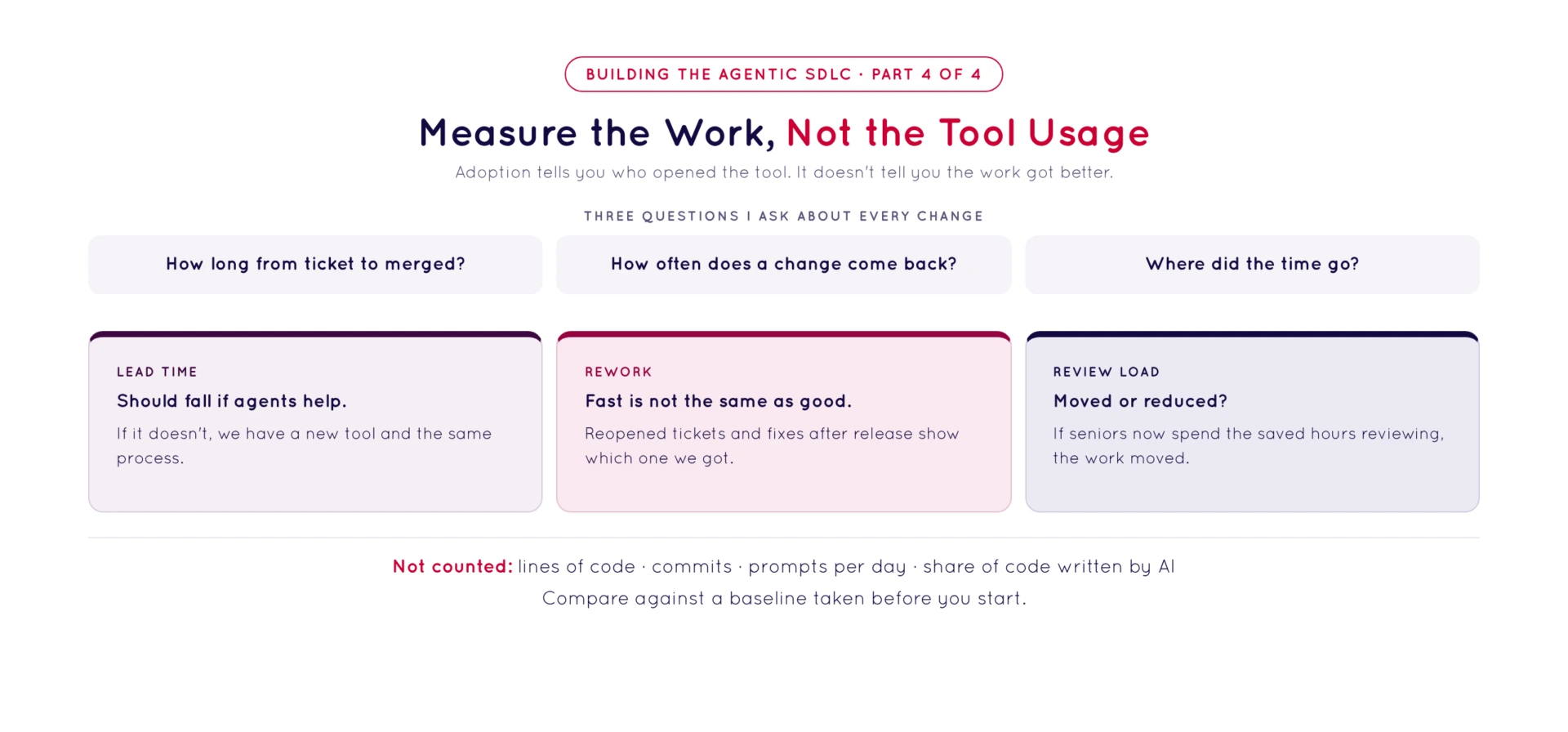
Adoption statistics tell you who opened the tool. They don’t tell you whether the work got better.
If I only knew how many people used an agent this week, I’d learn nothing about whether we ship better software. So I look at what happens to the work.
I ask three questions.
How long does a change take from ticket to merged? If agents help, lead time should fall. If it doesn’t, we have a new tool and the same process.
How often does a change come back? Rework, reopened tickets and fixes after release show whether the output was good or only fast.
Where did the time go? If agents write the code but our senior people now spend the saved hours reviewing it, we moved the work and didn’t reduce it.
There’s also something I look for that surprises people: how often a change is stopped. When a test, a written constraint or a reviewer catches an agent-written change, that means the layer is working. If nothing is ever stopped, I don’t assume the agents are perfect. I assume we aren’t looking closely enough.
On the product side, the finance agent I’m building is scored against a question set reconciled to the reports finance already trusts. I want that set to run on a schedule, so we notice if the platform quietly changes the model underneath us.
What I don’t measure: lines of code, number of commits, prompts per day, or the share of code written by AI. They are easy to count and say very little about whether the work improved.
One caveat: we’re early. I’d rather share what we watch than claim a big number we can’t back up.
What do you measure, and what did you stop counting?