10.10.2026 Building the Agentic SDLC: What Actually Works – Part 3
The most important decision in our FlexAM agentic SDLC was made before we chose a single tool: what the agents are never allowed to do on their own.
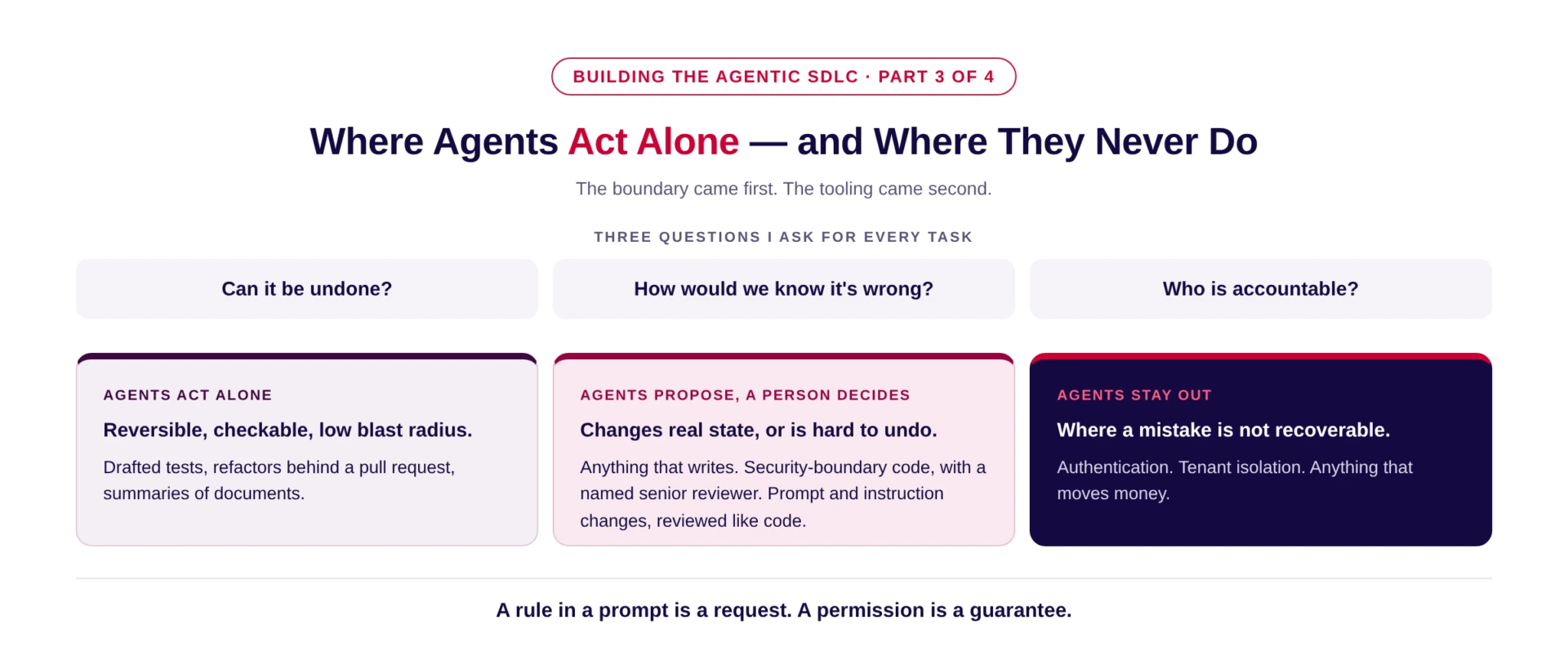
The boundary came first and the tooling second. When it happens the other way round, you find your limits after an agent has already crossed them.
For any task, I ask three questions.
Can it be undone? If a wrong result is cheap to reverse, an agent can usually act alone. Think of a drafted test, a refactor behind a pull request, or a summary of a document.
How would we know it’s wrong? If a failing test or a mismatch against a trusted report can catch the mistake, the agent can move fast. If only an expert would spot it, a person has to look.
Who is accountable? An agent can’t be. Somebody has to own what ships.
That sorts the work into three groups:
Agents act alone: reversible, checkable, low blast radius.
Agents propose, a person decides: anything that changes real state or is hard to undo.
Agents stay out entirely: authentication, tenant isolation, and anything that moves money.
In practice this looks fairly boring.
On the development side, generated code that touches a security boundary gets a named senior reviewer, even when every test passes. Passing tests tell you the code does what the tests expect. They don’t tell you the tests asked the right question. Prompt templates and agent instructions go through review like code, because they change behaviour like code.
On the product side, the agent I’m building for finance users can only read. It works through a gateway, with a key that reaches exactly one customer’s data. The write tools are switched off at the database permission level, and we test that they stay off. We don’t rely on the agent behaving well. If it is ever confused or tricked, the permission layer still says no.
A rule in a prompt is a request. A permission is a guarantee. I trust the second one.
Where a write path is planned, the design puts a person in front of it. They see exactly what will be created and approve it before anything happens.
One caveat: boundaries do move. An agent that builds a track record in one area can be given more room there. That should be a decision someone makes on evidence and writes down, not something that drifts because the tool was convenient.
Next in this series: what we measure to tell people using the tools apart from the work actually getting better.